
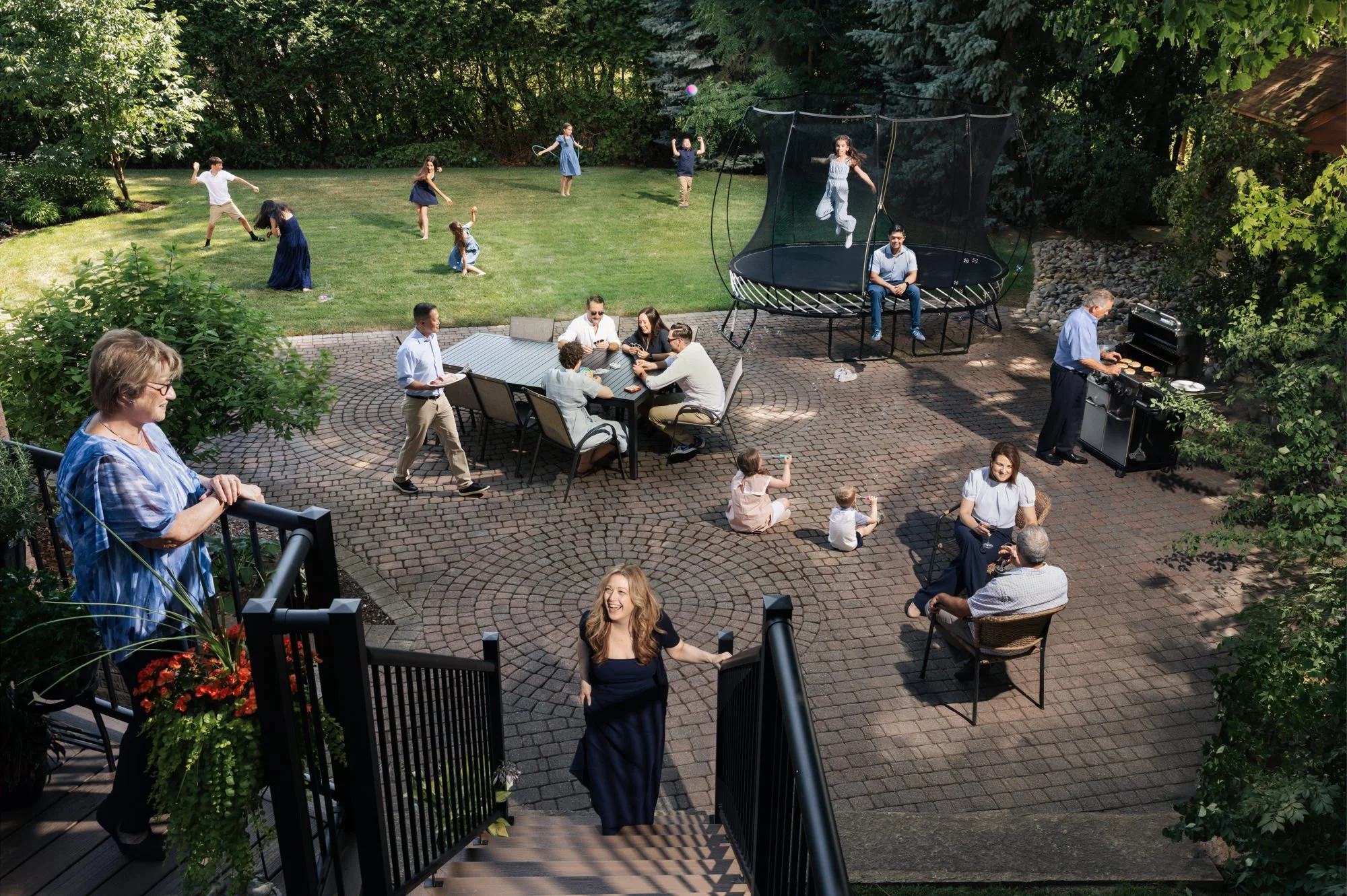
Some photographs are made in a fraction of a second. Others take three hours, twelve separate frames, and a fair amount of coordination to bring years of family history into a single image.
This one falls firmly into the second category.
Created for MSH Foundation in collaboration with Allcaps Content, the photograph accompanied a story about multiple generations of the same family who had all received care at the same hospital. The image was nominated in the Portrait Photography category at the 2026 National Magazine Awards: B2B.
The challenge was to bring an entire family together in one photograph while finding a visual way to communicate the idea of generations, shared history, and the passage of time.
Building the idea in layers
Rather than arrange everyone into a traditional family portrait, I wanted to create something that encouraged the viewer to explore the frame.
The idea was to build a series of smaller scenes within one larger scene, with different generations occupying different parts of the image. The backyard offered a natural setting for this. There were multiple areas where people could interact, from the lawn and trampoline to the dining table, barbecue, and patio.
The elevated camera position was an important part of the concept. It allowed us to see all these activities simultaneously, almost like looking into a dollhouse. Each group had its own little story, but together they formed a single portrait of the family.
I was particularly interested in using layers, both physically and conceptually. The grandparents in the foreground, the adults gathered in the middle, and the children playing in the background created a loose visual progression through the generations.
There isn't necessarily a prescribed order in which to read the image. You might notice the woman on the stairs first, then the girl jumping on the trampoline, then discover the smaller interactions happening around the table. I liked the idea that the photograph would continue revealing itself the longer someone looked at it.
Making a moment that never happened
Although the finished photograph appears to show everyone enjoying an afternoon together, that exact moment never existed.
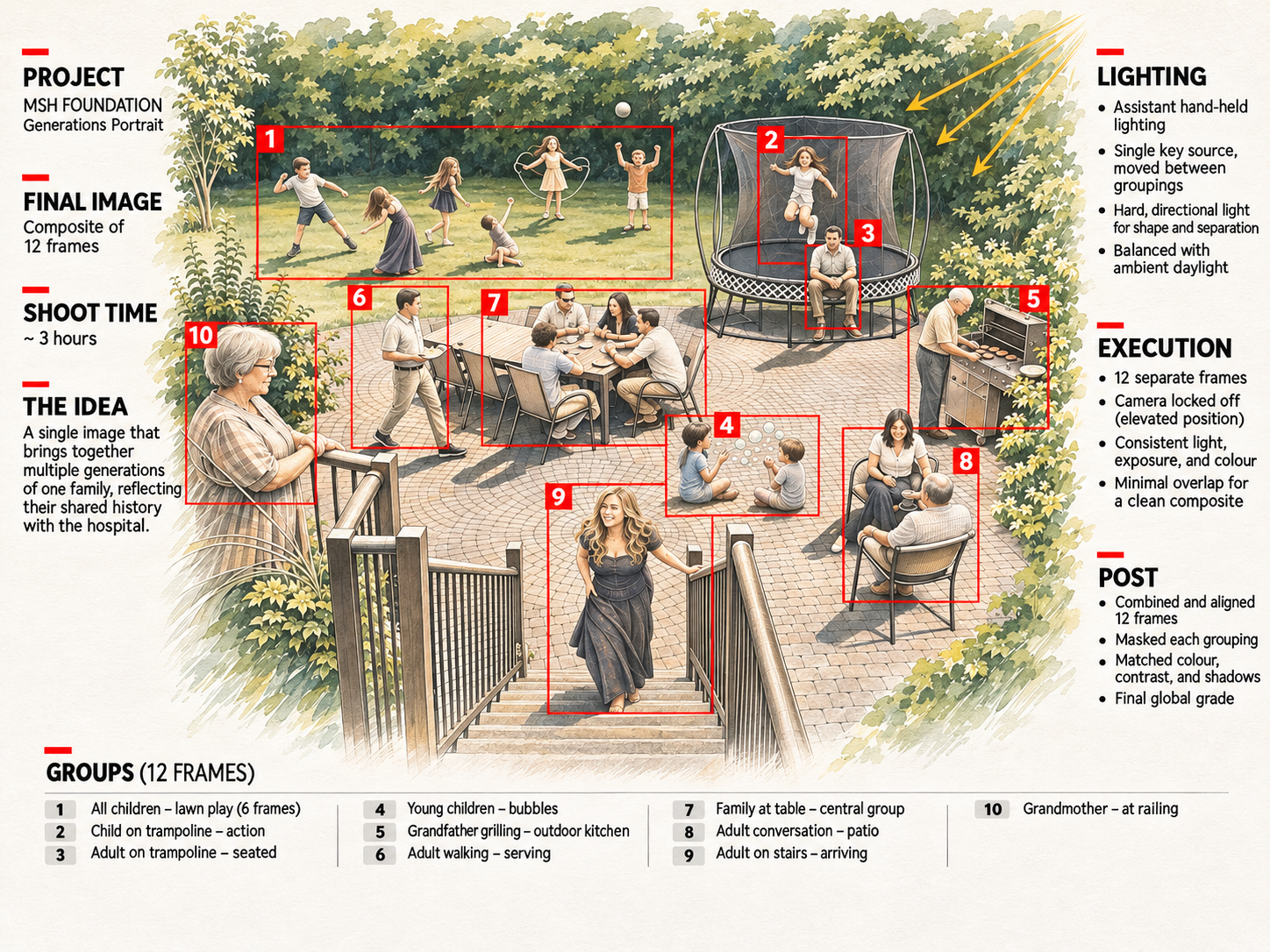
The final image is a composite of twelve photographs, made over approximately three hours. We worked through the backyard in smaller groupings, directing and photographing each scene individually.
A big part of the complexity was having to think several steps ahead, knowing exactly how the individual frames would come together in post-production. Before we started shooting, I had to work out which family members would occupy each part of the composition, where the different frames could overlap, and how to avoid people or objects interfering with neighbouring scenes. Camera position, perspective, lighting direction, and even the placement of shadows all had to be considered with the final composite in mind. There wasn't much room for improvisation once we got going. Every decision on set had consequences for the edit, so I was essentially working backwards from a finished photograph that didn't yet exist.
This approach gave me control over something that would have been nearly impossible to achieve in a single exposure: getting everyone in the right position, with the right gestures, expressions, and interactions, all at once.
It also meant thinking about the final composition long before we had all the pieces.
With the camera locked in position, each grouping needed to fit into a larger visual puzzle. We had to consider where people would stand, how their bodies would overlap, the direction of their attention, and how their movements would relate to the other scenes.
The challenge wasn't simply making twelve good photographs. It was making twelve photographs that belonged together.
A deliberately constructed look
One of the decisions I made early on was that I didn't want the photograph to feel entirely natural.
There is a certain visual language associated with lifestyle photography: beautiful available light, candid interactions, and the suggestion that the photographer just happened to be there at the perfect moment.
I wanted to push against that a little.
We deliberately gave the image a more lit, slightly theatrical appearance. The goal wasn't to make the lighting look artificial for its own sake, but to introduce a subtle tension between what appears to be an ordinary family gathering and the obvious precision of the composition.
Something feels just a little too perfect.
The people are separated slightly more than they might be naturally. The gestures are a little more deliberate. The light draws your attention to individual scenes in a way that the sun alone wouldn't necessarily do.
I like photographs that make viewers question what they're seeing, even if only for a moment. You understand the scene immediately, but something about it asks you to look again.
Lighting twelve pieces of the same puzzle
The lighting setup was relatively simple, even if the execution wasn't.
For each grouping, my assistant held a Profoto B1 on a light stand, positioning the light to give the subjects some shape and separation from their surroundings.
Working with a mobile light was essential (big thanks to my assistant, Andrew!). Rather than committing to one large lighting setup for the entire backyard, we could move from one scene to the next and adjust the direction and quality of light based on the people and their position within the composition.
The challenge was maintaining consistency.
Because the photograph was assembled from multiple exposures made over three hours, the ambient conditions were inevitably changing. The balance between flash and daylight, the direction of shadows, and the overall contrast all needed attention if the final image was going to hold together.
At the same time, I wasn't trying to make the flash disappear completely. I wanted that slightly heightened quality to remain visible.
The B1 gave us enough flexibility to light each group independently while preserving a consistent visual approach across the photograph.
There was also a practical advantage to photographing smaller groups. It allowed me to concentrate on individual expressions and body language without having to worry about what twenty other people were doing elsewhere in the frame.
Each scene could be refined on its own terms.
Bringing it all together
The final stage was assembling the twelve frames into one cohesive image.
A composite like this lives or dies by the small details. The relationships between people, the transitions between frames, and the consistency of light all contribute to whether the photograph feels convincing.
But convincing doesn't necessarily mean invisible.
I wasn't interested in hiding every indication that the image had been constructed. The slightly exaggerated lighting and carefully arranged interactions were part of the visual direction from the beginning.
What mattered was that the photograph felt unified, that your eye could move comfortably through the different scenes, and that the individual moments contributed to the larger idea.
Looking at the finished image, I like that it operates on two levels. At first glance, it's a big, lively family photograph. Spend a little more time with it, and it becomes a collection of smaller portraits, each representing a different relationship, activity, and stage of life.
That was always the intention.
For a story about generations of one family connected through the same hospital, it felt appropriate to create an image where everyone had their own place, but nobody existed independently of the whole.
And while the finished photograph may look like one very busy afternoon, it was really twelve carefully constructed moments brought together to tell a story spanning generations.
Special thanks to everyone who helped make this one so special:
The Crupi family
Client: MSH Foundation
Agency: Allcaps Content
Art Director: Taryn Dufault
Writer: Dave Yasvinski
Crew: Andrew Fleming
For syndication or licensing inquiries, feel free to get in touch.